
Welcome to the Leadership Academy Library!
This page acts as a resource hub for all Leadership Academy content and curriculum.
Ongoing Resources:
-
Fellow Roster
- Update your address and contact information!
-
Cohort Norms
- This is a living document! Please add to it as our community evolves and grows.
-
Choose An SSP Adventure (CASA) Program Planning Form
- Submit your ideas and plans for CASA programs.
Session Surveys:
Complete these after sessions two, four, and six!
-
Sessions One & Two
- Complete by April 1, 2021
-
Sessions Three & Four
- Complete by May 1, 2021
-
Sessions Five & Six
- Complete by June 30, 2021
January 4, 2021
Facilitators: Moe Leneweaver, Megan Taylor, Sarah Reynolds, Veronica Russell
Excerpt from Emergent Strategy
By Adrienne Marie Brown, literature from a Woman of Color on collective liberation.
“Wherever you are beginning this, take a deep breath and notice how you feel in your body, and how the world around you feels. Take a breath for the day you have had so far. And a breath for this precious moment, which cannot be recreated. Now, another for the day and night coming. Here you are, in the cycle between the past and the future, choosing to spend your miraculous time in the exploration of how humans, especially those seeking to grow liberation and justice, can learn from the world around us how to best collaborate, how to shape change…
Many of us have been and are becoming students of these systems of life, wondering if in fact we can unlock some crucial understanding about our own humanity if we pay closer attention to this place we are from, the bodies we are in…
Emergence emphasizes critical connections over critical mass, building authentic relationships, listening with all the senses of the body and the mind…
Emergence notices the way small actions and connections create complex systems, patterns that become ecosystems and societies. Emergence is our inheritance as a part of this universe; it is how we change. Emergent strategy is how we intentionally change in ways that grow our capacity to embody the just and liberated worlds we long for.”
Co-creating Definition of Leadership
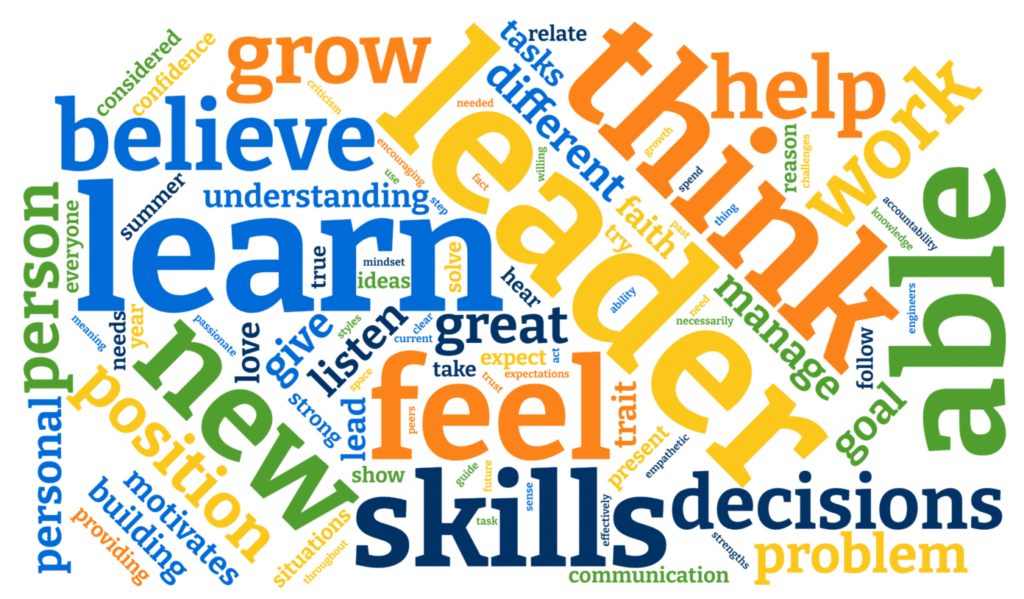
7 Levels of Leadership Consciousness

-
- 7 Levels (Barrett Values Centre)
- History:
- Inspired by Maslow’s Hierarchy of Needs; reinforced through Self-Determination Theory (SDT) and several other modern psychological studies on the conditions necessary for humans to thrive.
- “SDT is built upon the fundamental premise that human beings are naturally inclined toward growth and the realization of potential when afforded the opportunity to satisfy their basic psychological needs within their environment.”
- Developed in 1997 by Richard Barrett – emphasis on group or organizational consciousness and dynamics, rather than solely individual
- Rooted in understanding values, and how values beget action
- Inspired by Maslow’s Hierarchy of Needs; reinforced through Self-Determination Theory (SDT) and several other modern psychological studies on the conditions necessary for humans to thrive.
Ethics in Leadership: Questions for Reflection
- When did you first learn that you are (your racial identity)?
- What is your first memory of being aware that you are (your racial identity)?
- What strengths has this identity given me?
- What benefits has this identity provided me?
- How can I leverage those strengths and benefits for and with others, to create a more equitable culture wherever I go?
Session Recording:
February 3, 2021
Facilitators: Liz Pruchnicki & Elijah Ferebee
Session Recording:
March 13, 2021
Facilitator: McKenna Culbertson
Vulnerability & Connecting with Others:
Reflect on the quotes and questions below. Journal or share with a friend about your reflections.
“The special courage it takes to experience true belonging is not just about braving the wilderness… We’re going to need to intentionally be with people who are different from us… We’re going to have to learn how to listen, have hard conversations, look for joy, share pain, and be more curious than defensive, all while seeking moments of togetherness.” – Brene Brown
- What opportunities do you have to be with and listen to people whose experiences and opinions are very different than yours?
- What does your team or community do to make it safe for people to share their opinions and/or disagree?
- What other steps would you like to take to make it safer?
“True belonging is not passive. It’s not the belonging that comes with just joining a group. It’s not fitting in or selling out because it’s safer. It’s a practice that requires us to be vulnerable, get uncomfortable, and learn how to be present with people without sacrificing who we are. We want true belonging, but it takes tremendous courage to knowingly walk into hard moments.” – Brene Brown
- Do the teams you are part of reward authenticity or reward “fitting in”?
- What do you want to do to help create a culture of true belonging?
- Do you see people in your communities modeling belonging to and believing in themselves?
- What does it look like when people have the courage to speak up and take unpopular stances?
“…the key to building a true belonging practice is maintaining our belief in inextricable human connection. That connection – the spirit that flows between us and every other human in the world – is not something that can be broken; however, our belief in the connection is constantly tested and repeatedly severed.” – Brene Brown
- In what ways do the teams you’re part of share experiences of collective joy and pain?
- When you’re together, how do you talk about why these experiences are important and what they mean?
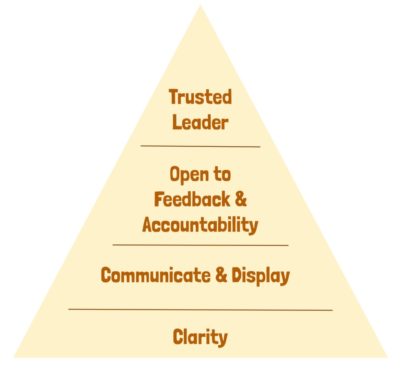
Foundations of a Team Leader:
- Clarity – Direct communication, your style, your expectations, understanding everyone has their own viewpoint. You can’t lead anyone if you’re not clear with your intent.
- Communicate and Display – Non-verbals; how are others perceiving your message? How you’re inviting and encouraging others. “Are you living out your expectations of leadership”
- Open to Feedback & Accountability – The most challenging barrier. Allowing yourself to be imperfect, humble, and honest. Being able to ask for help and accept when you’re wrong. “Lead and be lead by your own standards”
- Trusted Leader – Ownership, responsibility, lifting others, spreading the wealth. No gatekeeping growth. “Let everyone in, and build everyone up”
Session Recording:
Peer-to-Peer Fundraising:
In a non-profit context, it is especially vital for everyone connected to engage actively with supporting the livelihood of the community. This is another version of modeling leadership as part of a team!
One way to do this is through peer-to-peer fundraising. For any questions or ideas about this within the SSP community, contact Adam Vargyas. An example of a great peer-to-peer fundraising campaign is below:
March 29, 2021
Facilitator: Rob Rynders
Pre-Session Resources:
- 8 Steps Process for Leading Change
- What is Singularity?
- Rob Rynders: Future of Faith and Community
- 4 Strategies to Chart a Path Forward When There is No Map
- Acumen Academy: Human-Centered Design
- The course is free if you want to enroll, but doesn’t start until May 11
- Ted Talk: Trial, Error, and the God Complex
- Ted Talk: Grit – The Power of Passion and Perseverance
- Ted Talk: Success, Failure, and the Drive to Keep Creating
In-Session References:
- Presentation Slides
- The Sacred Secular: How God is Using the World to Shape the Church, by Rob Rynders & Dottie Escobedo-Frank
- Range: Why Generalists Triumph in a Specialized World, by David Epstein
- The Dip: A Little Book That Teaches You When to Quit (and When to Stick), by Seth Godin
- Russell & Hazel weekly journal (includes quarterly goal pages)
Session Recording:
May 1, 2021
Facilitator: Laura Steed
Pre-Session Podcast:
“As a precursor to our time together, if you’re out for a walk or sitting around looking for something to ponder, I’d love to suggest a podcast (or, earmark it for after the session if you’re swamped):
Tribe of Mentors: The Power of the (Unconscious) Mind
In this episode, Tim Ferriss interviews Adam Robinson. If you listen to it, my favorite part of the episode is when Adam is talking about his mission. I heard this episode about 2 years ago and I still hold on to this conversation and some key takeaways.” – Laura
Sustainable Leadership is…
- Purpose-Driven
- Resource Balanced
- Collaborative
- Socially Just
“We live in a uniquely unsettled moment of technological, political, and social flux. Awash in endless currents of information delivered by glowing screens, each new headline brings a fresh opportunity for faith or despair depending upon our attitudes and philosophies. By definition, anxiety and hope are determined by a moment that has yet to arrive—but how often do we pause to fully consider our relationship with the future?”
– A Monument for the Anxious and Hopeful
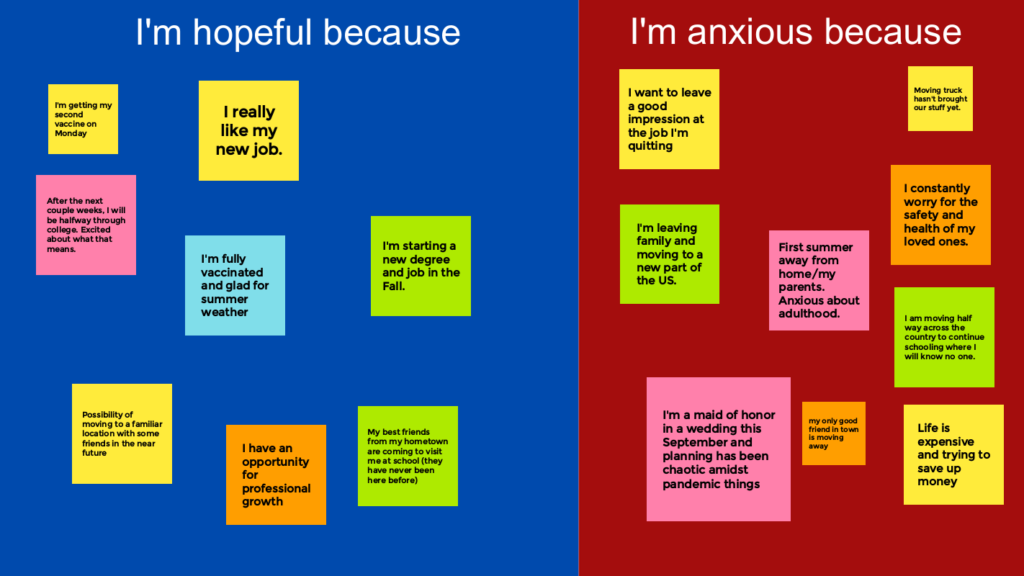
Sustainable Leadership as Purpose-Driven:
“Rocks into Blocks”
- There are 3 ways employees can approach work:
- Job: As a financial means
- Career: To strive for success & promotions
- Calling: As part of a greater purpose and part to a whole
- All of these are valid! You are likely to find the most meaning in your work via outlook #3 above.
- Additional resources on understanding your orientation to work from Psychology Today
Job Crafting Ted Talk (finding meaning in your work)
When you think about your purpose, what comes up for you?
Sustainable Leadership as Resource Balanced:
Saying NO is part of Sustainable Leadership. Think about an opportunity you said NO to recently. Reflect on your answers to these questions:
What was your level of comfort with saying no?
-
- Easy
- Moderately challenging
- Very hard
- I’ve never said No
I need to practice saying no:
-
- Yes please
- Not really
- I’ve mastered saying NO
- What is this No word you speak of?
I commit to spending some time developing my ability to say no some time…
-
- This week
- This summer
- Before I turn 30
- I’m saying no to this commitment
Revisit the Tribe of Mentors podcast from the pre-session resources. The speaker on the podcast says:
“I take on too many commitments because I sometimes have trouble saying no to others eager to work with me.”
Reflect on your own personal mission.
Sustainable Leadership as Collaborative:
Understanding the Drama Triangle:
- Persecutor
- Victim
- Rescuer

Reframing the Drama Triangle (TEDx Talk)
- Challenger
- Creator
- Coach
Reflect on a time you experienced the drama triangle, what role you found yourself in, and how you could have adapted your response or approach more akin to the TED version of the triangle.
Sustainable Leadership as Socially Just:
Leadership is not an individualistic activity. It is interwoven, intersectional, and means lifting others up.
Session Recording:
June 7, 2021
Facilitator: Chelsea Spyres